[et_pb_section bb_built=”1″][et_pb_row][et_pb_column type=”4_4″][et_pb_text _builder_version=”3.0.102″ background_layout=”light”]
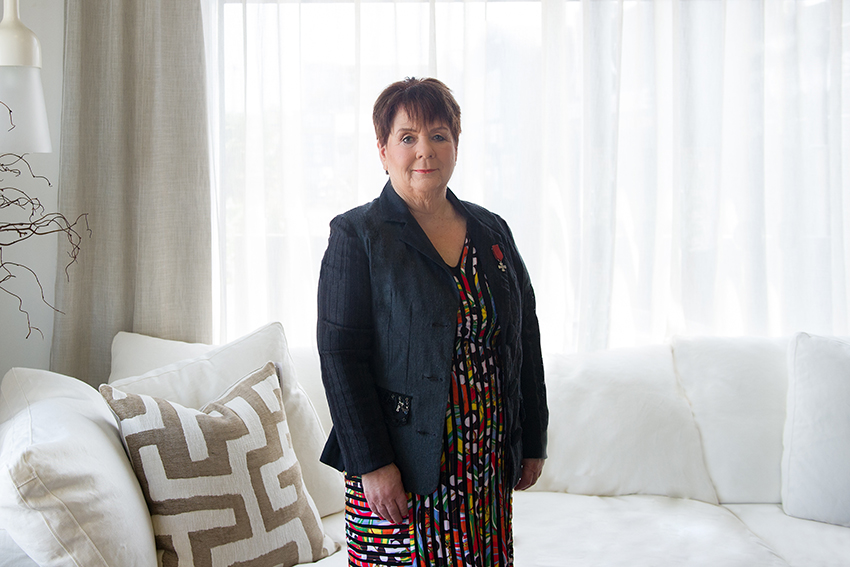
Courage and determination have characterised Frances Denz’s life, which is littered with achievements and hardship in equal measure. In terms of breaking barriers, Frances is something of a legend.
Images Nikki South, Nikki South Photography
Frances is one of four directors of the Stellaris Group, which offers business management training at two campuses in Auckland and Tauranga, consulting and training for New Zealand small businesses and community organisations. She has written four books, and run a number of successful businesses.
Frances is the founder chair of the Women’s Loan Fund – a microcredit scheme which had 17 branches at the height of its success. She has trained around 6,000 people in small-business skills, with around 75 per cent going on to successfully start their own businesses. She is one of only 43 registered women directors on major boards in New Zealand, and has been a trustee on a community trust with assets of $850 million.
Her abilities have been recognised by the awards she has received which include the honour of a Member of the New Zealand Order of Merit (MNZM), being made Senior New Zealander of the Year and being one of very few non-University or Polytechnic lecturers to receive the Tertiary Teaching Excellence Award (the so-called AKO Award). Whilst proud of these, she says her greatest achievements are the people who are living fulfilled lives because of the support, knowledge and skills she’s been able to offer them.

Rough Beginnings
But the achievements came on the back of a very rough start. At 18 she developed cancer and over the next 29 years underwent 12 operations and radiation treatment which left her with chronic pain requiring substantial medication. “My husband left me, and I faced financial ruin when the Government seized our land — 16,277 acres. In a further blow, the cancer came back. I was abandoned, ill and destitute on the streets of Wellington when there was no benefit system for married women,” she says.
This was the 1970s, when it was still possible to walk into the Prime Minister’s office without an appointment. Desperate and determined, Frances became the first married woman to get a sickness benefit, after doing just that.
“I told him the effects of his Government’s actions on us when they took our land. He listened, gave me some food, and organised a benefit for me,” she says.
Self-employment was Frances’ way out of poverty. She has started a number of businesses over the years including a private retirement home, a tourism safari park, a free-range chicken farm and a garden centre. Later she set up a private training company teaching disabled people the skills to become self-employed.
She has also dabbled in politics, and was a high ranking member of the Labour Party’s women’s committee during the Helen Clark years. She later dropped out of the political arena for a couple of years, only to be drawn into ACT, which she says had a very left wing social side, although its economic policy was that of a right wing party.
She was hit hard by the economic reforms of the 1980s, when successive government changes destroyed her new business, more than once. “I set up a new business based on a contract with a State Owned Enterprise. This contract was for a million dollars of work over time. Within two months the Government changed the rules, and the work could no longer be contracted out to us. Each time I have picked myself up and started again.”
Back to health
In 1991 she set out to wean herself off the pain medications that had become a mainstay of her survival, and what followed was 29 years of good health. In this time she has flourished. Her second book, Able to Do Business was published internationally, and she has published three others privately in New Zealand. Writing books has become her response to stress and pain – “it diverts my mind and keeps me focused,” she says.
She has remained single and shares her Tauranga waterfront home with her Burmese cat. The section is covered in native bush and backs onto a reserve, and the tranquil outlook is a welcome respite from a busy life.
Frances owns Stellaris with fellow director and friend Ron Scott. The pair met during the political years and have successfully worked together for the past 14 years. It’s a partnership that she says is founded on having the same ethics and values, despite being ‘diametrically opposite in how we think.’
“We’ve shared an office for years and we get along well. But we don’t live in each other’s pockets and we don’t socialise together outside work. We talk through each decision and I can’t think of a time where we haven’t reached a consensus,” she says.
Adapt to change
Despite having written extensively on goal setting, she says her views on this have changed as she has gotten older. “Goals are important but resilience and adaptability are more important, as the world is changing so quickly.
“Ongoing learning and a commitment to adapting to the world is more valuable than the goals themselves.”
Frances practises what she preaches, and has relished new skills gained this year in being part of tertiary research around learning and teaching. “As a Private Training Enterprise (PTE) offering level 7 qualifications, we have to undertake research. This year we were involved in a cooperative enquiry project with a Massey University research team, which explored and validated teaching methods we were using in our classes.”
Frances’ focus has always been experiential rather than academic, however she has greatly enjoyed working with the Massey researchers. “It turns out that I’ve invented methods of teaching that have accredited theories behind them,” she says. For the (AKO) Tertiary Teaching Award, she had to write an 8,000 word portfolio that was judged by 12 academics. “It’s the first time I’ve ever had my own work assessed. I’ve had no formal education and was teaching outside the mainstream system. Winning the award gave me huge confidence, as not only was our work judged hugely effective for students, it was up to the standard of the universities.”
At 75 Frances says her biggest challenge has been overcoming her own sense of inadequacy. “Finally I’ve realised that it doesn’t matter – it’s one of the good things about getting older,” she says.
Despite having suffered a heart attack five years ago, she has no plans to slow down. “Why would I retire?” she says. “I love being in business and I still have lots to do.”
[/et_pb_text][et_pb_divider _builder_version=”3.0.102″ show_divider=”on” color=”rgba(12,113,195,0.76)” /][et_pb_post_nav _builder_version=”3.0.102″ in_same_term=”off” show_prev=”on” show_next=”on” /][/et_pb_column][/et_pb_row][/et_pb_section]