A lot has changed in the Tauranga CBD landscape recently – we’ve welcomed Our Place, the first container city in the area and the major reconstruction of the Red Square corner building brought colourful ultra-modern vibes to Downtown… But the most significant update has definitely been the opening of the brand-new University of Waikato tertiary campus at Durham Street earlier this year.
The sleek black building is an impressive add-on to the ever-evolving CBD scene. Its façade was inspired by the skin and dynamic motion of the mangopare (hammerhead shark). This creature represents strength and resilience – exactly what’s required to succeed in your studies! But it’s also a reminder to the university itself – to be a longstanding tertiary partner for Tauranga and the Bay, it needs to be resilient!
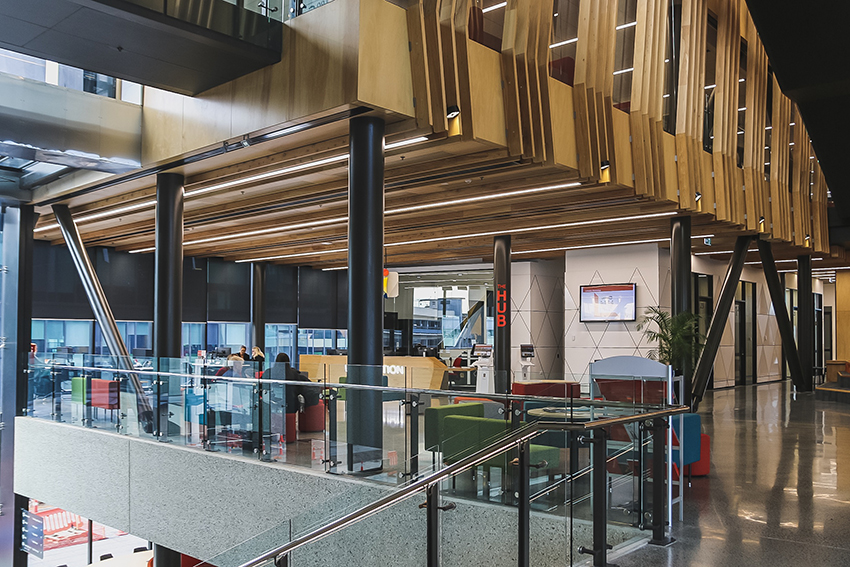
The Hub on the first floor is a place for students to come for any information or to just relax and socialise
Actually, it’s already difficult to imagine Tauranga without the University of Waikato campus. Not only because we’ve witnessed the process of its construction for the last three years and become accustomed to it, but also because of the deep cultural roots it has managed to plant in the area from the very beginning.
Even before creating the actual construction site, Auckland-based architects Jasmax spent time at the local Huria marae, alongside the community of Ngāi Tamarāwaho (as mana whenua of the CBD area where the campus building is located) to discuss the cultural identity and draw inspiration for the future outlook of the building. Everything you see in the interior and exterior of the campus has a deep connection with local history and culture. Even the tiniest engravings on the windows that are easy to overlook, represent the Bay of Plenty landscape! Of course, all ten artists involved in decorating the campus live locally in the Bay as well.
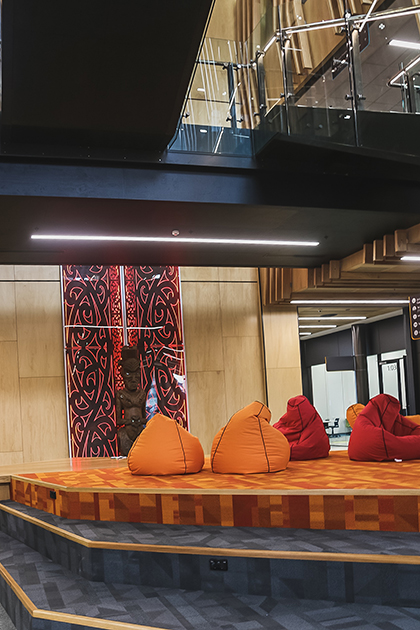
Though not everything here is only about the Bay. It’s still a University of WAIKATO after all and a tribute to its origin is an ancient kauri tree, sourced from a swamp in North Waikato. This tree was used as the material for the wooden carvings throughout campus.

The Pouwhenua is carved from ancient kauri that was pulled from a swamp in North Waikato. A single piece of solid kauri engineered 3 metres deep into the ground and standing 6 metres high. It honours the mana of the local iwi and hapū of the area.
It’s only been a few months since the campus was first opened with a dawn karakia ceremony in February 2019, but over 50 lecturers have already taken 900 students on board at the spacious, high-tech building. By ‘hi-tech’ we mean a good four levels of the previously unseen blend of local traditions and the most advanced technologies to create a perfect environment where students enrol to work hard towards achieving their dreams.
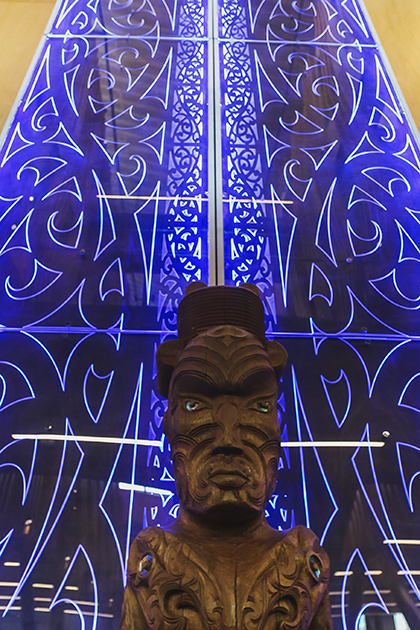
The campus design has a ‘village concept’ with multiple entrances, communal areas for students to communicate and socialise and private study rooms, nooks and corners. There is a lot of natural light and air inside. But the heart of the campus is, without doubt, the giant 18-metre high Poutokomanawa (centrepost) in the main atrium. As a clear message to students, the panel reflects Tane’s and Tawhaki’s ascent into the heavens to receive the baskets of knowledge. The acrylic kōwhaiwhai panels of the Poutokomanawa change colour at the push of a button, bringing another dimension of innovation and versatility to the installation. For example, the plan is to light up the kōwhaiwhai panels in pink for the Breast Cancer Awareness month in October, which we totally support!
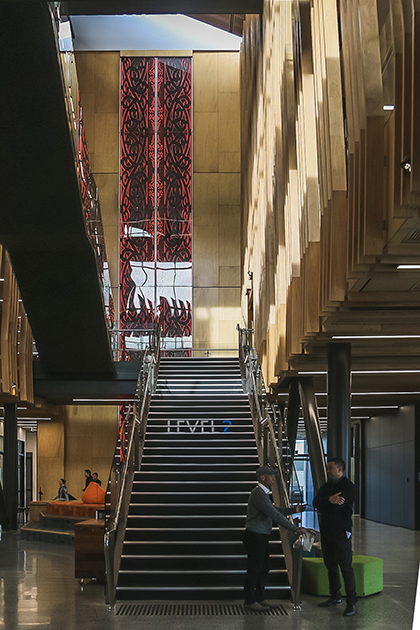
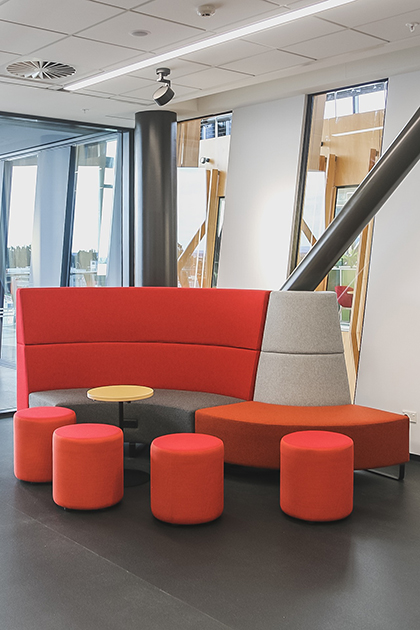
You’ll also surely be impressed with the bright red sofas with soundproof fabric and electrical sockets in the public areas (can we have one at the office, please?), a 24-hour computer lab, and plans in the foreseeable future to livestream their public lectures.
Te Manawaroa, the university’s multifunction centre, deserves a mention of its own. This space has been created for teaching and learning, as a conference room, social and noho space. It’s equipped with a large projector screens for presentations, a lectern for speakers and plenty of seats. Modern? Yes. But at the same time, in many ways, it draws inspiration from a traditional wharenui/ meeting house – but with added versatility to either relax or to apply strict tikanga protocols – depending on the nature of the occasion.
The feature wall of Te Manawaroa is decorated with installations that follow the traditional formation common in the meeting houses of Tauranga moana and beyond, consisting of a central post and extending outwards with eight alternating panels of tukutuku (woven panels) and pou whakairo (carved panels). Central pieces are traditional in materials and designs while outer panels have more contemporary techniques. Framed by floor-to-ceiling windows, it’s a truly impressive spot!

This room and a massive 200-seat lecture theatre enabled the University of Waikato to finally hold their annual graduation ceremony within the campus. Previously they had to book other venues in Tauranga for this purpose! When walking around the building you easily sense that both students and lecturers truly feel at home here. They finally have everything they need – from large rooms to fit everyone comfortably to tiny cosy nooks on the ground floor where students can eat their lunch or study in private.
It would be a mistake to think that the comfort of the new University of Waikato Tauranga campus is only available for enrolled students and employees. Everyone is welcome to visit the campus at any time. Of course, once they open the café that’s currently under construction, it will be even more exciting. But even now you can go along and enjoy the vibrant atmosphere, great views and, of course, visit free public lectures from University staff. There are also spaces available on campus to book conferences and events.
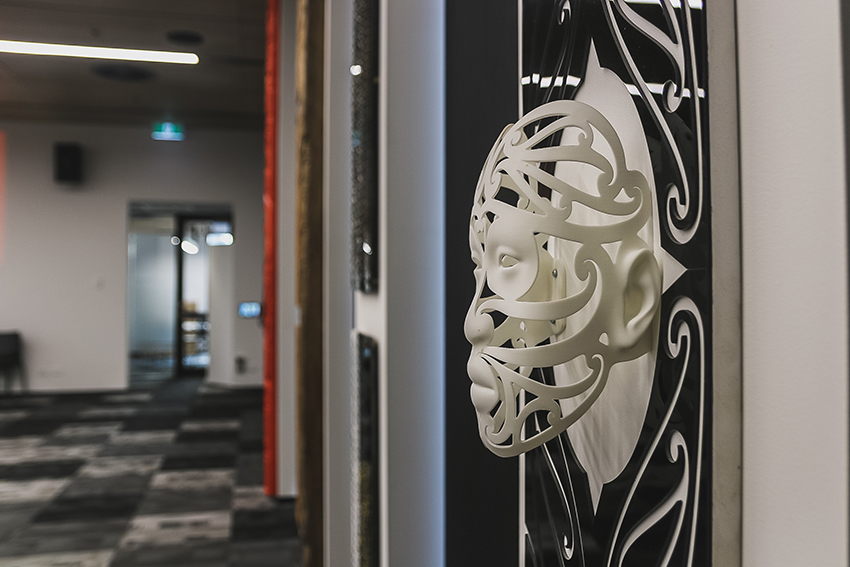
Ngā Hau e whā by Kereama Taepa. The 3d-printed panel represents four winds. The features of each face are unique, representing the diverse cultures of the world and within the University community.
Text and photos: Kseniia Spodyneiko