Four and a half years ago, Diana Anderson from Tauranga adopted her first greyhound – a sleek black girl named Zeva. Before signing up with Greyhounds As Pets (GAP), Diana had never met a greyhound face to face, nor did she know much about the breed. What she wanted was a dog that needed a home.
Now she’s General Manager for the Greyhound Adoption Programme Trust, also known as Greyhounds As Pets, responsible for a dedicated team of paid staff, contractors and volunteers around the country, and tasked with the goal of rehoming up to 600 greyhounds every year.
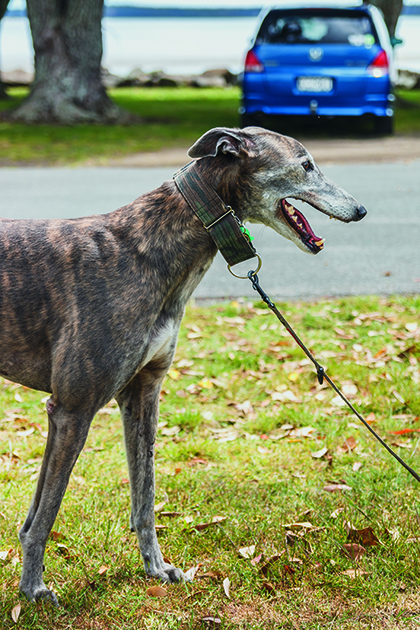
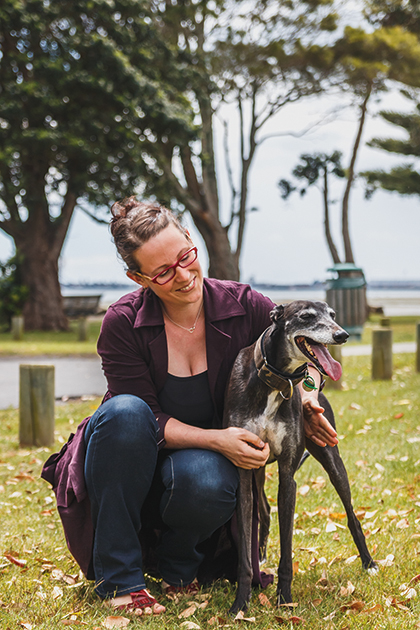
For Diana, greyhounds are the perfect pet – intelligent, affectionate, non-aggressive, and, contrary to what most people think, don’t require lots of exercise. They are so chilled they hardly bark at all – another plus, unless of course you want a guard dog. The real drawcard however was finding out that greyhounds don’t smell, slobber or lose much hair all over your furniture, and many are happy to sleep all day while you work. She was sold! Zeva quickly stole Diana’s heart, and before long, she adopted her second greyhound, Achilles, a big blue-brindle* boy.
[/et_pb_text][et_pb_blurb _builder_version=”3.0.106″ url_new_window=”off” use_icon=”off” use_circle=”off” use_circle_border=”off” icon_placement=”top” use_icon_font_size=”off” background_layout=”light”]
*brindle – mottled or tawny fur colour, with coloured streaks
WILLING ADOPTERS NEEDED
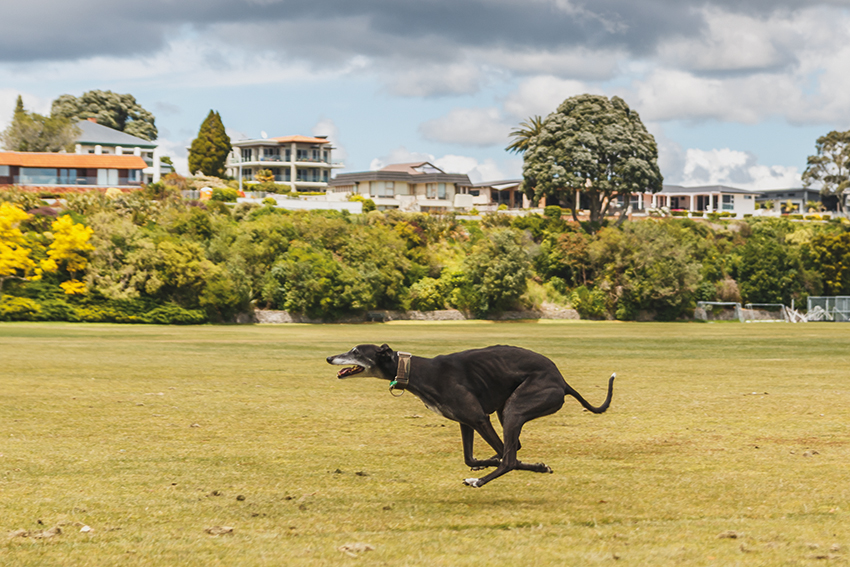
Greyhounds are sight hounds which means their keen sight will spot potential prey a kilometre away. Their athletic, cheetah-shaped body also makes them fast; coupled with the love of a chase, they are prized on New Zealand’s racetracks.
GAP is a charitable trust set up by Greyhound Racing New Zealand (GRNZ) in 2005 to rehome retired racing dogs, or those greyhounds who, for whatever reason, never made it to the track.
The industry is GAP’s main sponsor but the organisation is racing neutral and does not get involved in the racing side of it. “Our aim is to find homes for all retired greyhounds and to do this we need more people to adopt them,” says Diana.
To supplement GRNZ funding, the organisation has formed partnerships with Nutrience dog food and teamed up with some vets around the country but still relies on sponsorship and donations from businesses and individuals to help pay for operational costs including vet appointments and food for dogs awaiting adoption.
While GAP and other smaller organisations rehome approximately 450 dogs in total each year, it’s still not enough. Outcomes from the 2017 Hansen Report (an independent review of animal welfare in the greyhound racing industry) included recommendations for the industry to implement population management controls and establish an annual census of greyhounds in New Zealand. These changes are underway, and combined with a potential increase in the number of willing adopters, Diana hopes to reach a point where all dogs will be rehomed.
Public education to dispel perceptions is therefore a big part of GAP’s role, and volunteers around the country talk with people at various events, like A&P shows and pet shop adoption days, encouraging them to meet a greyhound face to face.
“People are often concerned they will not be fit enough to own a greyhound, but despite their racing background, these dogs don’t need lots of exercise. They are sprinters, not endurance athletes. Sometimes I wish I could get mine off the couch!” she says.
Another misconception is that greyhounds are considered aggressive because they are muzzled during a race, but this is because of their competitive nature and because their skin is very thin, says Diana.
“We want people to meet a greyhound and see that they’re happy lying around and often have children cuddle them. Perceptions have definitely changed since I first became a volunteer. Now people come up and say, ‘I heard they make really great pets; can we talk about that?’ We’d love to hear more of that.
“Zeva and Achilles are the ideal companions for me and they’ve helped me learn to calm down when I get stressed. They pick up on my energy, so if they’re going crazy in the house, I recognise that it’s me who needs to calm down.”

FINDING HER PLACE
Diana, from Germany, came to New Zealand in 2004 to study at Massey University for the honours year of her biotechnology degree. She was 24. Initially she struggled with the cold Palmerston North winter in an unheated house, but soon grew to love the less formal environment, the friendly people and easy access to the great outdoors.
“I went home for a couple of months to submit my thesis and then applied to return to New Zealand for my Masters in Agribusiness. I came back knowing that I wanted to live here and unless I was kicked out I wouldn’t be going back.”
Over the next 10 years after graduating, as well as getting New Zealand citizenship, she worked in the horticulture industry. Most of that time was in the Bay of Plenty as inventory and harvest manager for two large kiwifruit postharvest operators. But stress took its toll, working 7-day weeks for about a third of the year.
“I reached a point where I didn’t recover anymore between seasons and I realised I needed to do something else.”
Initially, the something else became a business analyst role with an IT company, and later a sales role. But it wasn’t the job for her.
“I thought I’d be less stressed but I wasn’t; I was constantly run-down and sick. I realised what kind of impact stress can have on your life and did a lot of soul searching to figure out what’s really important.”
She had already started volunteering at GAP soon after adopting Zeva, and for two and a half years had a part time role as regional coordinator for the Waikato and Bay of Plenty. When the General Manager role came up, she knew it would be her dream job.
She is now responsible for all facets of the organisation, from staffing to operational management, to strategic planning – having her hands in a variety of tasks is the perfect role for her, she says.
“When I talk about greyhounds people think I’m such a great sales person but that’s because I truly believe in the product. They make wonderful pets and I want to see all of them rehomed. I have chosen to do something I really love and because of that I feel calmer, happier and my health has improved. I still have a weight on my shoulders but it’s a good feeling because there is purpose to what I do.”
Anyone can adopt a greyhound – families with young children, single people, couples or retirees. What matters is matching the personality and temperament of the dog to the adopter’s lifestyle. Volunteers meet with potential adopters to find out what they’re looking for, whether they have young children, other pets, and whether their home is fenced. Prior to adoption, all greyhounds are desexed, vaccinated, health checked and registered. Post-adoption, GAP staff keep in touch to ensure the new greyhound is settling in well.
To find out more about adopting a greyhound visit greyhoundsaspets.org.nz


