How Kristy Hunter and Stine Smith turned a supermarket walk, a shared sense of purpose and one very good Swedish dishcloth into a growing sustainable homecare business.
Sometimes a business idea doesn’t arrive with a carefully crafted five-year plan. Sometimes it starts with two women walking through a supermarket and looking around thinking: Surely there has to be another way.
For Kristy Hunter and Stine Smith, that moment became the beginning of Good Change, the Bay of Plenty sustainable homecare business they founded in 2019.

What they saw was hard to ignore. Aisle after aisle was filled with cleaning products wrapped in plastic, alongside synthetic cloths and sponges that would ultimately become waste. There seemed to be plenty of choice – but very little choice for someone who wanted products that were better for the planet without compromising on practicality, affordability or good design.
So they decided to make their own.
What began in children’s playrooms and the boots of their cars has grown into a trans-Tasman business generating more than $1 million in annual revenue, with products now stocked in more than 250 Woolworths supermarkets across Australia and more than 500 independent retailers.
But the numbers, impressive as they are, aren’t really the point.
For Kristy and Stine, Good Change has always been about something bigger: proving that small, everyday decisions can add up to something meaningful.
A meeting of very different worlds
The pair didn’t come from traditional sustainability backgrounds.
Kristy’s career had taken her through sales, marketing, sponsorship and fundraising, including roles in FMCG and retail in both New Zealand and London. Stine had a more corporate background, beginning in sales with IBM before moving into management consulting in the UK and Middle East, and eventually arriving in New Zealand with Fonterra as a Change Manager.
It was their shared desire to do something positive that brought them together.
And then came that supermarket trip.
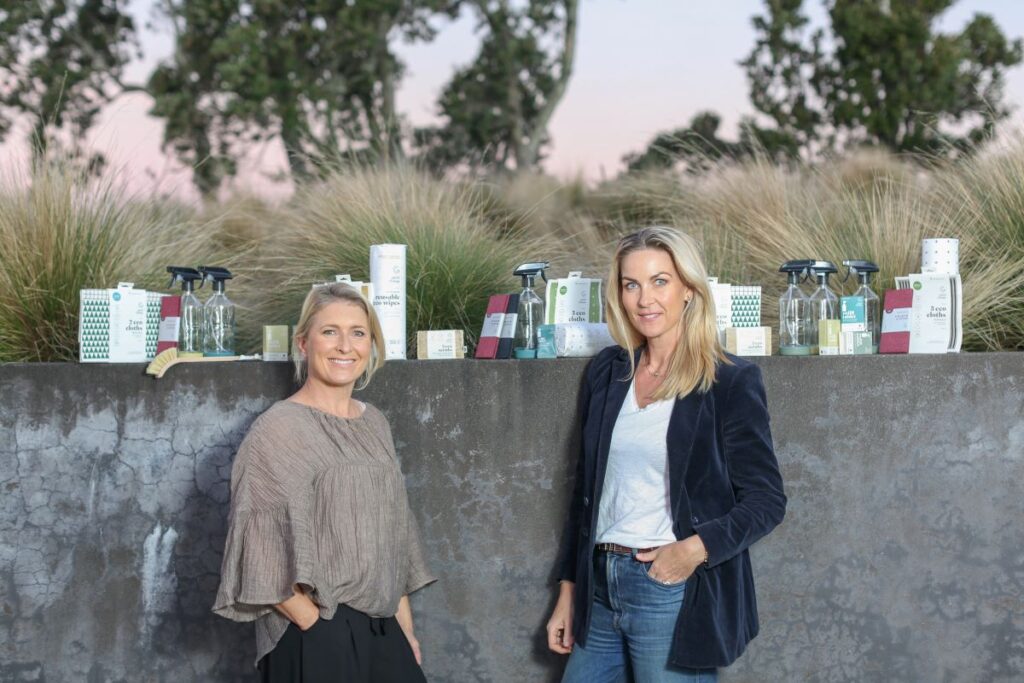
They began noticing just how much plastic surrounded everyday household products, particularly in the cleaning aisle. There were natural and sustainable products beginning to appear in other areas of the supermarket, but the women saw a gap.
They didn’t want to create an expensive, worthy-looking product that people admired but didn’t actually buy. They wanted something ordinary households could afford, something that looked good sitting on the kitchen bench, something that worked – and something that genuinely reduced waste.
Stine also brought with her an idea from home.
Originally from Denmark, she remembered a natural cloth she had grown up with – a simple, functional product that wasn’t widely available in New Zealand. The cloth was compostable and could be used for months before being returned to the earth.
It became Good Change’s first flagship product.
And, importantly, it set the standard for everything that followed.
It had to be more than ‘green’
From the beginning, Kristy and Stine were determined that Good Change wouldn’t become another small eco brand tucked away on the shelves of gift shops.
They wanted scale.
They wanted their products in supermarkets, where they could reach ordinary families rather than only consumers who were already deeply committed to sustainable living.
And they wanted the products to tick several boxes at once: affordable, attractive, functional and genuinely better for the environment.
That philosophy remains central to Good Change.
In 2022, the company introduced what it describes as New Zealand’s first locally manufactured refillable bench spray concentrate tablets, made with New Zealand botanicals and essential oils and paired with a reusable glass bottle.
The range now includes products such as All Purpose Cleaner with Green Tea & Lily, Kitchen Cleaner with Citrus & Lemon Myrtle, and Bathroom Cleaner with Eucalyptus & Mint.
The idea is simple: make the more sustainable choice an easy choice.
Small changes. Big ripple effects.
Perhaps the most interesting thing about Kristy and Stine’s approach is that they aren’t asking people to become perfect environmentalists.
Quite the opposite.
They know that zero waste can feel overwhelming. Organic food isn’t always affordable. Not everyone has the time, money or inclination to completely overhaul the way they live.
Their philosophy is to start somewhere.
Stop using plastic wrap. Try reusable containers. Replace paper towels with something reusable. Plant a few herbs or some lettuce. Think twice about the products you’re picking up in the supermarket.
One small change can lead to another.
As Stine puts it, once you make one change and realise I can actually do that, you begin to feel empowered to make another.
That idea of the ripple effect has become part of the Good Change story.
The company’s work extends beyond selling cleaning products, too. Through school fundraisers and educational initiatives, Kristy and Stine use their business to start conversations with young people about waste, plastics and the choices we make as consumers.
Because if one child goes home and talks to their parents about what they’ve learned, the conversation continues around the dinner table.
And that’s where small changes start to become something much bigger.

Business with a purpose
For both women, giving back was part of the vision from the beginning.
Their experiences travelling through parts of Asia, including Cambodia, exposed them to the devastating effects of waste and limited access to clean water. Good Change now supports families in Cambodia with clean water, with the company stating that one family receives clean water for every product purchased.
It’s another example of the philosophy behind the brand: a product doesn’t have to be simply a product.
It can be a vehicle for change.
That belief also shaped their decision to create the Good Change Conversations podcast, where they talk to people doing positive things across areas such as sustainability, farming, packaging and mindset. The idea is to leave listeners with practical takeaways they can actually use.
There’s no suggestion that Kristy and Stine have everything figured out.
In fact, they’re quite comfortable admitting they don’t.
Their message is refreshingly realistic: none of us is perfect, and trying to live completely waste-free is difficult. But doing something is better than doing nothing.
A business that lives its values
Walk into Good Change’s headquarters in the Bay of Plenty and the philosophy behind the brand is hard to miss.
The purpose-built workspace sits on Stine’s avocado orchard and is completely off-grid, powered by solar energy. There are composting systems and a vegetable garden for staff.
It’s a physical expression of something the founders clearly care about: the business itself should reflect the values they are asking their customers to embrace.
And the growth hasn’t changed that.
If anything, it has given them a bigger platform.
Today, Good Change products are available throughout New Zealand and Australia, with warehouses in Tauranga and Melbourne and ambitions to expand further.
The company’s reusable cloth range alone has, according to Good Change, prevented the equivalent of 18 rugby fields’ worth of synthetic cloths from ending up in New Zealand homes and landfills.
That’s a lot of dishcloths.
And then came AI
For a business that began with two women and a simple idea, Good Change has also embraced a decidedly modern way of working.
AI is now used across marketing, content, administration, finance and customer service, allowing their three-person full-time team to operate with the capacity of a much larger organisation. The founders say marketing revenue has quadrupled since embracing AI, while email revenue has tripled and Google impressions have also tripled.
But there’s an interesting distinction in the way they use it.
They aren’t trying to make the business less human.
Their approach is what they call the 10/80/10 rule: humans provide the direction, brand knowledge and creative instinct; AI handles much of the planning, production and optimisation; and humans return at the end to add the judgement, personality and detail.
It’s a philosophy that feels surprisingly consistent with everything else they have built.
Use the technology. Use the tools. Find a smarter way.
But don’t lose the human part.
Good change doesn’t have to be perfect
Perhaps that’s why the story of Kristy and Stine feels bigger than a cleaning brand.
They aren’t preaching perfection. They’re asking better questions.
What if we stopped accepting that something has always been done a certain way?
What if we chose reusable instead of disposable?
What if businesses could make money and make a difference?
What if a product could look good, work brilliantly, be accessible to ordinary people – and still be kinder to the planet?
And what if changing the world didn’t require one enormous gesture, but millions of small ones?
For Kristy and Stine, that’s the whole point.
Good Change began with two women seeing a problem in a supermarket aisle and deciding they could do something about it.
Five years later, their small idea has travelled from an avocado orchard shed in Te Puna to supermarket shelves across two countries.
Not bad for a couple of small changes.