You probably know by now how to minimise the coronavirus risk: wash your hands with soap and use hand sanitiser regularly, work from home when possible, avoid close contact with other people for over 15 minutes, shop online, etc. But it’s not just people who could spread the virus. How about the surfaces we touch? Here is everything you should know about keeping your house properly clean during the coronavirus outbreak.
How long does coronavirus survive on the surfaces?
There are different types of viruses and different types of coronavirus as well. But SARS-CoV-2 – the virus behind the current pandemic situation – lives for up to 72 hours on plastic and stainless steel surfaces, for up to 24 hours on cupboards and for 4 hours on copper.
In 2020, the Journal of Hospital Infection analysed 22 different types of coronaviruses and figured out that some other types survived on metal, plastic, and glass surfaces for four to five days. If the conditions were ideal for them, they could survive for up to nine days.
It’s not quite clear yet how long the coronavirus can survive on fabric but it tends to last longer on stainless steel than on fabric. Smoother fabrics – think silk or synthetic – generally, show less microbial contamination than natural fibres like wool or cotton. Keep that in mind if you have to leave the house!
Don’t let the amount of coronavirus types scare you! According to a recent article in National Geographic, only seven of them can affect people, with four causing nothing more than a mild cold.

How to properly sanitise your house and keep it clean from coronavirus
Cleaning hard surfaces like tabletops, doorknobs, countertops, sinks, and glass to protect your family from coronavirus isn’t actually that hard and doesn’t differ a lot from what we normally do.
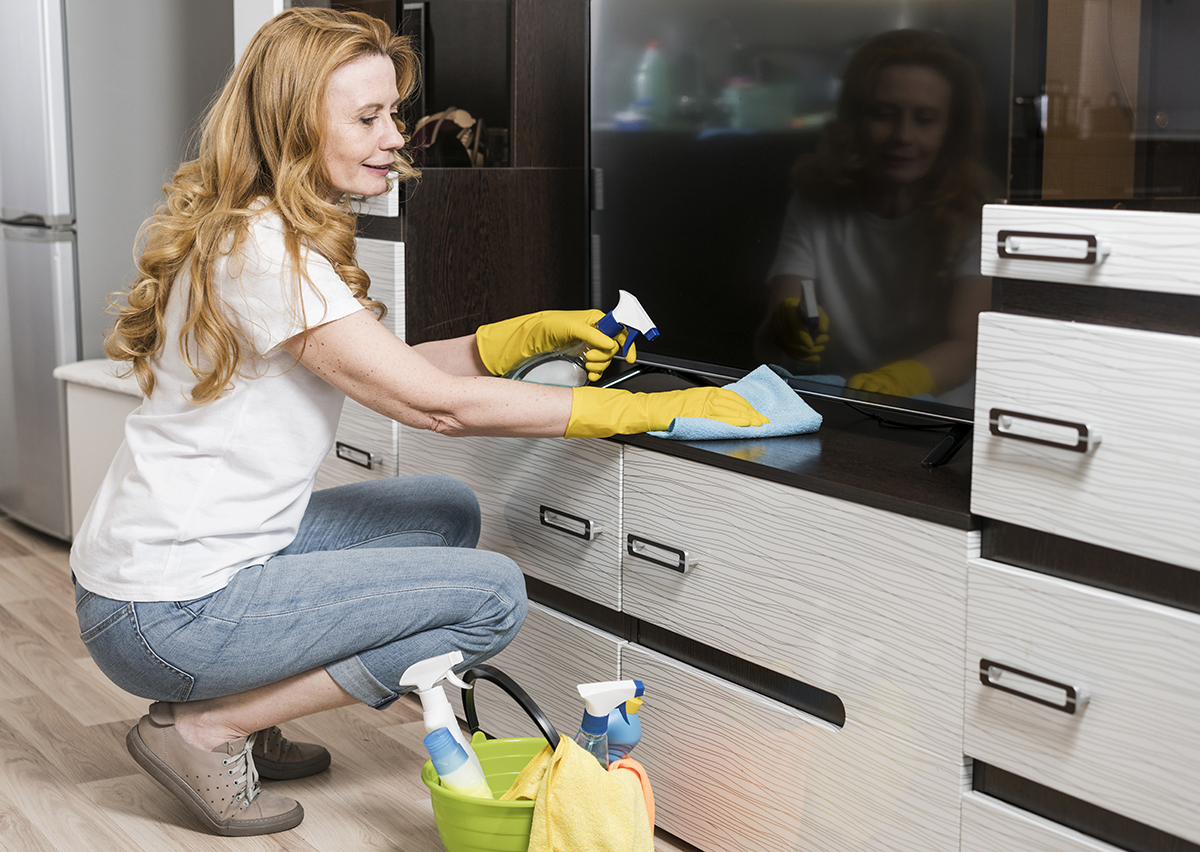
First of all, make sure you wear gloves! You’ll be using some harsh disinfecting products and you don’t want to hurt your skin. And of course, you don’t want your skin to come into close contact with possibly infected surfaces for more than 15 minutes.
To clean hard surfaces, use alcohol-based disinfecting wipes or solutions that contain at least 70% alcohol. Diluted bleach solutions are also a good idea.
How do you check you’re using enough disinfecting product to kill coronavirus? For example, if you’re using alcohol-based wipes, make sure the surface remains wet for at least four minutes. If it dries out quicker, you’ve probably been using the same wipe for too long now and you need to use a new one.
According to the Journal of Small Animal Practice, washing your clothes at 30 degrees or higher significantly decreases the bacterial burden on fabric. Colour-safe bleach diluted with water helps with further sanitising. It’s important not to over-fill your washing machine – rather give your clothes more room to stir in the disinfecting, soapy water. The high-heat drying cycle is key to eliminating viruses.
If someone in your home has been sick (which, we hope, never happens!), sanitise your laundry basket and the washing machine as well.
Images: Freepik