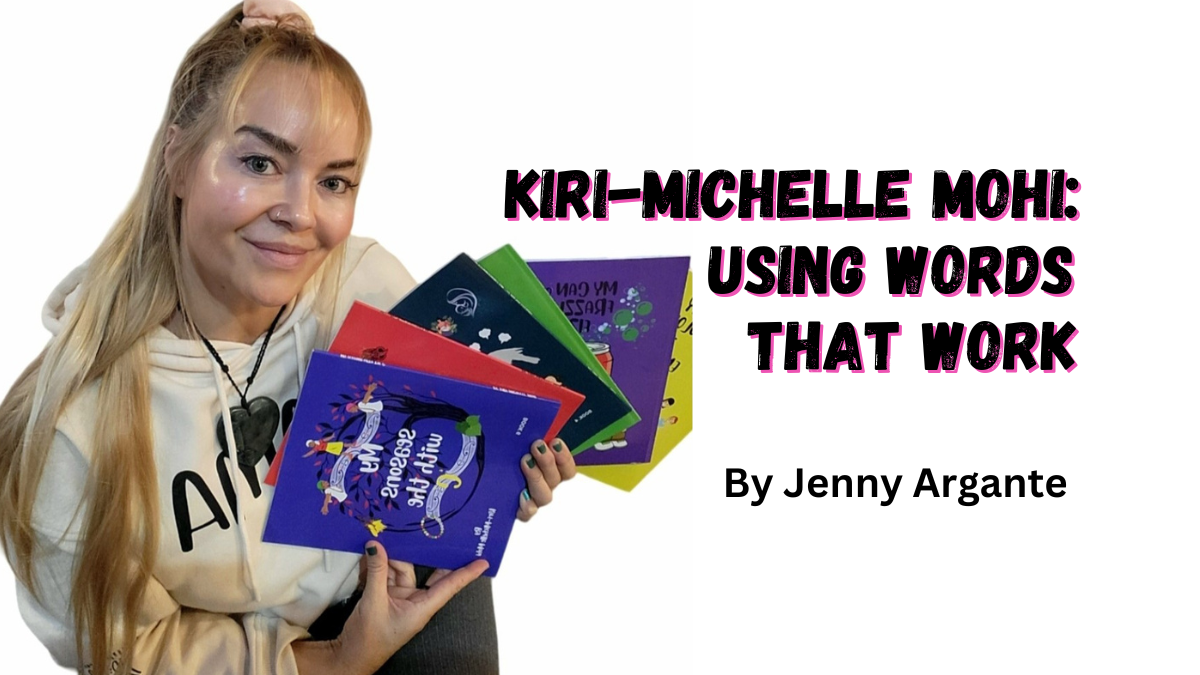
I first met Kiri-Michelle Mohi at a women writers’ workshop in Maketu, September 2022. This was organised by local author Angie Belcher, who has a formidable number of children’s books to her credit. Angie has always had a passion for sharing ideas and expertise with other aspiring creatives, and brings energy and good humour to whatever is the business in hand. Myself and other established authors were there to interact with attendees who had a particular writing project in mind, sharing information and skills that would help them to achieve individual goals. Soon that energy and good humour was working through the group of mainly Maori women, and we were buzzing.
Being immersed myself in the world of books, and trained as a children’s librarian, I was particularly interested in what one attendee was working towards: Kiri-Michelle Mohi. We later met one-on-one to run through some of her ideas before she applied for seed funding. I was impressed by the thoroughness of Kiri’s research and her good understanding of what was needed and what she wanted to deliver. Kiri had a vision in mind that I was enthused by and I was curious to learn more about her. In subsequent interactions I heard how she had worked steadily to bring that vision to an established reality, naming it Fruits of Te Arawa Publishing.
When we next met, I asked Kiri to describe herself. “I am the mother of four and grandmother of five,” she said first. “I am Ngati-Rangiwewehi and Te Arawa, and the youngest of four daughters. I have a degree in social work and a postgraduate diploma in clinical supervision. Presently I work as a dual diagnosis practitioner in the field of drink and drug rehabilitation.
“I grew up near to Pukehine beach and began my education at Pongakawa Primary School. I had a Dad who used to recite poems and sing songs to us. I’m sure that’s where I first learned to appreciate the power of words. Like many Maori, he tackled all sorts of work to provide for the family. He was employed in the Te Puke meat works, and was also a possum tracker, good with fencing and a keen fisherman.”
Kiri pauses to reflect for a few minutes. “I think we had the best kind of childhood. I’m the last of my sisters by some years. I was probably Dad’s last shot at getting a son, and he treated us no differently from how he would have treated a boy. The most important lesson we learned from him was the value of hard work, and that you can do anything if you put your mind to it. My mother is Australian, with a Scottish father and Swedish and German ancestry. What Mum passed on to us was the virtues of temperance and morality, of staying on the straight and narrow. Basically, theirs was a marriage of opposites that has lasted.”
Where did Kiri’s writing journey begin?
“I worked as a social worker in schools (SWiS) for ten years, interacting with the children and their whanau, and with community services. I was always on the lookout for resources to use with the children in order to address different social and personal issues. There was an unavailability of appealing resources that could cater to a wide age range. I wanted books for our tamariki that are colourful and glossy. I wanted the words to rhyme – I believe, for children, they absorb the meaning better when it does.”

That is exactly what Kiri has now developed and delivered in the books she has created. In kohanga reo, playcentres and primary schools they’re becoming known as real, raw resources, and for good reasons. Fruits of Te Arawa titles are not your typical bedtime story. They are for the reader and the child who listens to work together. Awareness is created by the conversations that ensue. Whatever it is, the child gets to understand it is not their fault, or they are not alone, and that change can be an outcome. That is because a child’s voice speaks from within each book.
And the stories touch not only the children, but the adults who can now identify with the children in the books, and recognise them, too. As Kiri says, “It’s the adults who need to hear the messages in order to understand how to best support the child and look outside the child’s behaviour.”
The books from the Fruits of Te Arawa certainly fulfil that purpose. Each title in the series has a different bright colour, so users can say ‘the yellow book’ or ‘the blue book’ as sometimes titles are hard to remember. When I ask Kiri when the series will come to an end, she laughs. “When we run out of the social, physical and emotional problems too many of our tamariki face in the home, at school and in the community. When parents and teachers stop coming up with new topics for me to consider. At this stage there is no shortage of ideas firing through.”
I am not surprised at the feedback Kiri is getting, as the resources coming from Fruits of Te Arawa have two unique factors. Firstly, they are written in the child’s own voice, voices she has listened to intently in her years as a social worker. Secondly, they are not meant to be read or listened to by the child alone. That works well as a preparation for literacy, or as an introduction to the power of story. These books need a significant adult – parent, teacher or librarian – who can work through a particular title with the child, encouraging response and opening up discussion.
I asked her about income, always the most problematic aspect of indie publishing, and was delighted to hear of good sales, especially in Te Puke and Rotorua. She added, “We must be doing something right, due to support from social media and the local Bay of Plenty community. We haven’t advertised that widely, but word of mouth recommendation is working well for us, and that’s the best kind. We need to keep sales going, as the money that comes in is used to reprint existing titles and publish what’s upcoming.
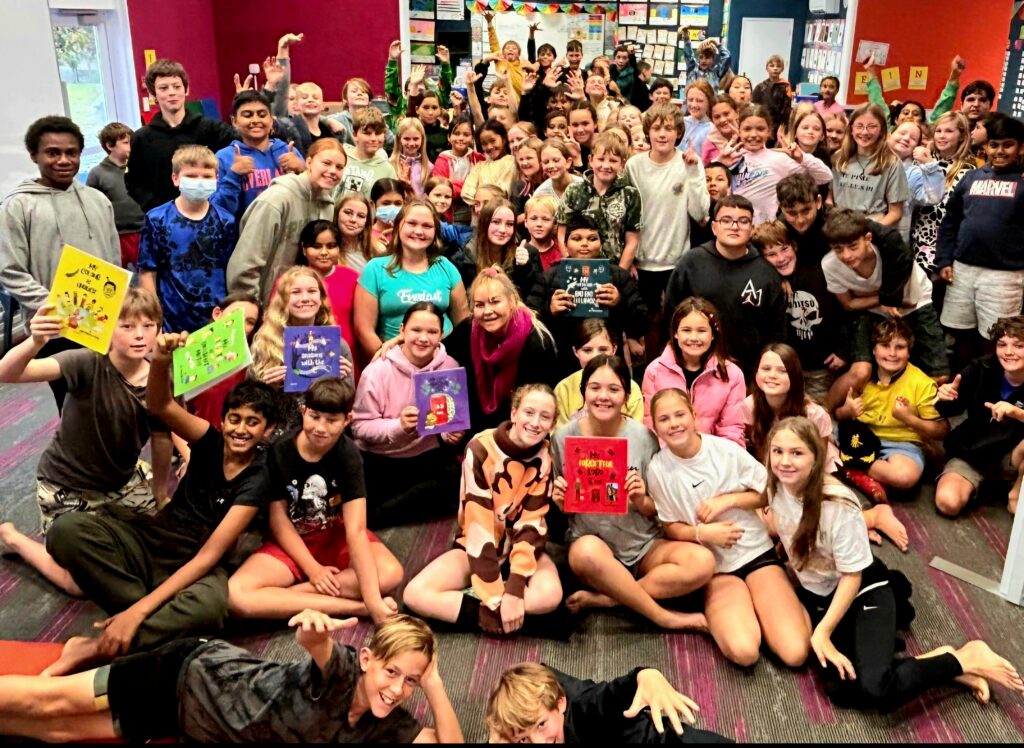
“When it comes to spreading the word, I also do school visits as often as I can. It’s important that parents, teachers and others working with young children know that these resources are meant to be used by adult and child together. That’s how dialogue ensues, and how questions and uncertainties can be addressed and a coping strategy developed.”
She has a final message to deliver. “The success of Fruits of Te Arawa has been more than I ever envisaged. I want to encourage other wahine out there to put pen to paper and write down what you want to do. To find your own creative niche and pursue it with drive and passion. For me, this venture has been enlightening and empowering and I can definitely see the force that creativity can bring to enhance well-being and mental health – and hopefully, a little wealth, though that is not the reason that I do it.”
I think we know that, Kiri.
An active Facebook page on Fruits of Te Arawa Publishing can be found HERE or follow on YouTube.
Books for this not-for-profit organisation are stocked in many PaperPlus stores in the Bay of Plenty.