Dee Collins found a lump on her breast when she was living in Australia. Because she was moving between Brisbane and the Sunshine Coast, she was temporarily unlisted with any medical practice. So instead of a visit to a GP, Dee called in to a breast cancer centre, and was instantly offered a mammogram.
WORDS: JENNY ARGANTE
IMAGES: SANDRI BLOM
PHOTO EDITING: ALEX SPODYNEIKO
HAIR AND MAKEUP: LAURA LEMOS
OUTFITS: MAGAZINE CLOTHING
LOCATIONS: THE ART LOUNGE NZ, THE NOURISHED EATERY
This came back clear, but Dee insisted on ‘a second opinion’, which was secured through an ultrasound scan. There was something there and a biopsy revealed the presence of cancerous cells. Says Dee, “I would strongly advise any woman who senses something is still not right to go with their intuition and push for a follow- up. We’re told if we find a lump to go to a doctor immediately and it’s well-known the earlier a woman is diagnosed, the quicker treatment can begin and the higher her chances of a full recovery.”
Dee had a lumpectomy and the biopsy revealed that she had an aggressive Grade 3 ductal carcinoma which was HER-2 positive. She was now with a GP, and tells us, “The doctor described it as oestrogen-driven. My husband Mark and I had both been married before and wanted a child of our own. We’d been trying for some years, and I had undergone IVF fertility treatment.”
Sadly, this never resulted in motherhood for Dee, and perhaps the oestrogen supplementation that is part of IVF lingered too long in her system. One never knows the reason.
HOPE, HARD WORK AND FOCUS
But Dee is not a person to stay in the negative and doesn’t say much about her trials or tribulations. She’s a woman of hope, with no fear of hard work, and whose entrepreneurial spirit and enterprise has ensured a rewarding level of achievement, both personal and professional.
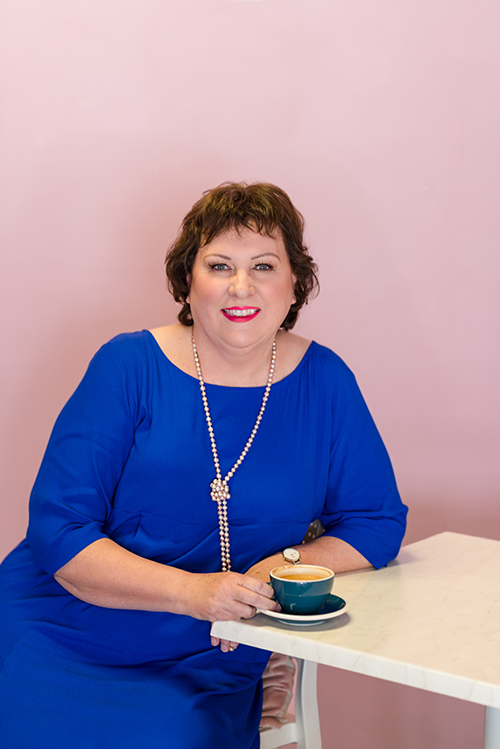
Meeting Dee for the first time, you cannot fail to sense the energy and purpose in her. She is friendly and confident, and presents as a stylish, attractive woman of intelligence and good humour. You suspect she strives to work to a high standard, both as an individual and within a team. Dee constantly praises those who work with her and for her, and you guess it’s no accident that she now owns a printing and packaging company with her husband Mark and that the magazine she produces is called focus.
With such a strong sense of what she knows she’s capable of and such a positive attitude to challenges – and Dee has faced many – she refused absolutely to be intimated by the Big C.
“I was fortunate,” she asserts. “I was living in Oz at that time, and the drug Herceptin wasn’t funded in New Zealand-Aotearoa, though it is now. Herceptin works by attaching itself to the HER-2 receptors on the surface of the breast cancer cells and blocks them from receiving growth signals. This slows or stops them spreading.”
CHOICE IS IMPORTANT
Dee believes it is important to refuse any concept of being a victim when cancer strikes. She understands that if knowledge is the power, then information is the key. Dee came to the conclusion she needed to study what would work best for her. She decided to go for a mix of medically-prescribed drugs and treatments with alternative therapies, these to be adopted if deemed useful in a direct or supplementary role.


“When you’re working with a medical team to get well, it’s important to listen to them, yes. It’s also important to realise it doesn’t have to be one thing or the other,” she says now.
“We do have choices. So I asked questions and I read up on my illness. That did evolve into a course of treatment that I had faith would work best for me at the time. I wanted to maximise both physical and emotional wellbeing. Taking charge helped me to stay optimistic for a positive outcome.”
She pauses to smile, somewhat wryly. “Like many patients, I found chemo in particular exhausting. There are different kinds of chemo and everyone does chemo differently.” At that time, she owned a bridal exhibition business – what Dee describes as being ‘Sunshine Coast wedding-day vendors’ – and that involved commitment, networking and a fair amount of travel. She also created the Sunshine Coast Wedding Guide, which was her first foray into the magazine and publishing arena.
“Too often my mind was in a fog, I got confused and my energy levels could rapidly drop to nil at any time. That, for me, was the worst part of my cancer experience. But I was determined not to be beaten.”
Dee fully acknowledges she couldn’t have done so without the support of family, who, albeit living in New Zealand, rallied around, especially her husband Mark.
“It is often hardest on the partner,” Dee reflects. “The patient has her own struggles and they are expected to carry on and care for her, and life for both of you becomes a little like being a hamster on a wheel. There’s the routines of the medication, the drives to and from the treatment centres, appointments with specialists and the strain for your partner of being outwardly cheerful, being the mediator between you and the world you are both now dealing with.”


She leans forward to emphasise what she says next.
“Look, I’ve been tremendously lucky. I met Mark when I had given up looking and I have never wished for anything better. I was relatively new to Australia when I fell ill and had not yet been able to build a circle of close friends. On my own without him, it would have been a lonely battle.”
RISING TO CHALLENGE
One thing that was particularly hard was her father dying soon after she was diagnosed.
Yet Dee has faced tough challenges before. Born in Zimbabwe while it was still Rhodesia, she entered a world where a long, fierce battle for independence was being fought, and a country that began to crumble with a dictator who was determined to inflict ruin with his Marxist ideology.
Under the iron-clad, 40-year rule of Robert Mugabe it was a country that eventually disintegrated into conflict, crime and chaos, the forced sale of farms long-held by the descendants of settlers, and famine and economic collapse.
As with many other Zimbabweans, political instability, a deep uncertainty about what the future might hold and the collapse of the rule of law prompted Mark and Dee to emigrate. Dee’s brother had already moved to Christchurch, and that’s where they headed, together with Dee’s parents. Later, after nearly eight years in Australia, the couple came back to New Zealand to put down permanent roots.
“It had to be in a region with interesting possibilities,” says Dee, “and the Bay of Plenty beckoned. Most of my career has been in exhibition and event management but I wanted a change. We bought a printing company and I launched focus. I describe it as a lifestyle and business magazine about women, by women and for women. I was tired of the gossip and negative news in the media and wanted a magazine that would empower, inspire and shine a spotlight on the amazing women in the region.”
With cancer, there is always a chance of recurrence after remission or cure but Dee refuses to dwell on such a possibility.
“The cancer journey isn’t easy but, at the end of it, I’ve found there is hope. I’m also a life coach and I don’t think negativity can ever be helpful. Since my illness I’ve become more health conscious, favour an organic diet and try to take care of mind, body and spirit. I try to get the work-life balance into sync but it doesn’t always happen…”
It’s obvious that Dee believes it’s best not merely to survive cancer, though it’s definitely an achievement of merit. It’s better, once it’s beaten, to thrive.
Something Dee Collins seems to have made a habit of.


