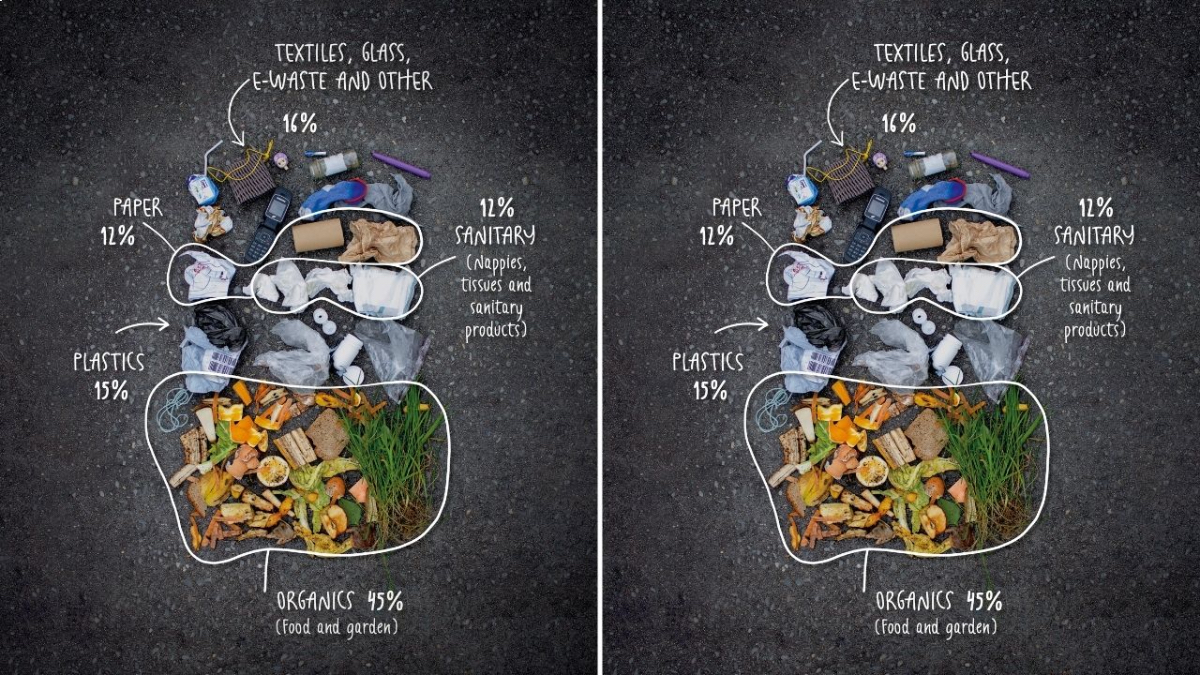
Starting to reduce waste is a super-tangible way to tune in to our consumption and start making a difference. Here are a few tools and insights to help you navigate the waters of waste without it taking over your life.
IS RECYCLING REALLY THE ANSWER TO ALL OUR PROBLEMS?
Recycling is based on supply and demand. If there’s value in the system, then it works; if there’s not, it can get a bit messy.
Take plastics as an example. We’re consuming way more plastics than anyone could have predicted. There’s a whole lot of supply going into the system, without the right level of demand for the end product.
Not all plastics are created equal. Some plastics can be recycled easily and repeatedly, but others not so much. Some types, such as soft plastics, often suffer from downcycling where the end product is a lower grade and has limited uses.
Just because things are recyclable doesn’t mean it happens. The National Geographic Society estimated that only 9% of all plastics ever made have been recycled, and lots of it ends up in the environment.
Because we want things to be recyclable, we’ll often end up putting things in our recycling bin that aren’t actually recyclable – coffee cups, plastic toys and plastic bags. Despite our good intentions, these products can end up contaminating the recycling, and may mean the whole batch goes to landfill. Check your local council’s website to make sure you’re getting it right.
Time, energy and resources go into recycling. Even if something can be recycled, it still takes a heap of resources to make it. We’ll use it for a short amount of time, then put it into our recycling bin. Someone comes along and collects, transports, sorts andprocessesit,andthentransportsitsomewhereto(hopefully) be used again.
Recycling can be a good alternative to sending things to landfill, but it’s complex. There are a whole lot of other actions further up the waste hierarchy that are a better choice. Ideally, we need to be shooting for buying and using less overall and keeping thingsinuseforaslongaswecan.
Read also: Think before you bin it: how to safely dispose of dangerous items.
WASTE REDUCTION IS A BETTER SOLUTION
Being more conscious of waste boils down to three simple questions:
1. Do I need it?
2. How can I source it better?
3. What happens to it at the end of its life?
When I’m deciding what to do to reduce my waste, I use my rubbish bin as my guide. Every time I’m ready to make a change, I look in my bin, see what’s there and choose the next easiest thing to focus on. It really doesn’t matter where you start – just pick something, and make it an easy one to get you going.
Reusable bags, cups, safety razors … there is no shortage of Instagram-worthy tools to take you on a waste-reduction journey but, before you rush to the shop, there are a couple of things to think about.
1. Use what you have. I’m a sucker for a well-designed stainless steel container or good-looking reusable coffee cup. But there’s a certain irony in going out and buying new shiny stuff to reduce my waste. Most of the time, I already have things I can use. It already exists, so let’s not waste it.
2. Over and over again. Buying tote bags, cloth nappies or stainless steel drink bottles, then stashing them in a cupboard doesn’t somehow mystically reduce your impact. Use them, or pass them on to someone who will. Have folding bags and collapsible containers that fit in your handbag, keep extra bags and cups in your car, stash old plastic bags in your glove box – whatever it takes for you to get your hands on your reusables when you need them.
Read also: Reduce, Reuse, Refill and Refuse: simple ways to avoid single-use waste.
MAKING THE RIGHT CHOICES IS EASY
Whether it’s packaging solutions or products, I get that navigating all the options and trying to make a better choice can be a bit full on. Remember: it’s not about the perfect choice, it’s about better choices – rolling with any of these will mean you’re making a conscious decision.
1. Can I take my own? From fruit and vegies to meat, honey and takeaways, it’s becoming more and more common to rock up with your own reusables to skip disposable packaging waste.
2. Can it be reused? Glass jars are a favourite in our house; I reuse them for storing and freezing all sorts of things.
3. What happens at the end of its useful life? I choose paper over plastic because, after reusing it as much as possible, it can go into my worm farm or compost.
4. How easy is it to recycle? I choose items sold in tin cans (try to find cans with BPA–free plastic lining) and glass over plastic, as there’s more demand for these in the recycling chain. Recycling glass and cans is also way more energy efficient than creating it from virgin materials.
5. Can it be composted? Compostable packaging and products are a good choice if they’re actually going to make it to the compost – if there is a commercial collection in your area or if it states it’s home compostable and that’s where you’re going to put it, then all good.
6. Can I buy less of it? I’ll always start with a micropause to check if I really need something, or if I can simplify how many different things I’m buying. If I decide to buy something, I’ll see if there’s a way I can reduce the packaging waste. I’ll choose bulk package sizes to reduce overall waste. Buying in bulk doesn’t have to mean buying things by the pallet load, it’s as simple as buying a larger package size or switching to toilet paper in double-length rolls. Buying items in concentrated or solid bar form also reduces the need for excess packaging because you’re getting the product without all the water.
7. Has it already been recycled? Choosing products made out of recycled materials is a great way to help create demand in the recycling chain.
8. How does it come packaged to the store? While I might be walking out package-free, if there’s packaging in the supply chain, I like to be aware of it. I want to see if there’s any way I can reduce it, or maybe I can take it home to reuse it.
Extracted from Living Lightly:
The Busy Person’s Guide
to Mindful Consumption
by Nicola Turner
(HarperCollins NZ, RRP $45.00)
Available now.