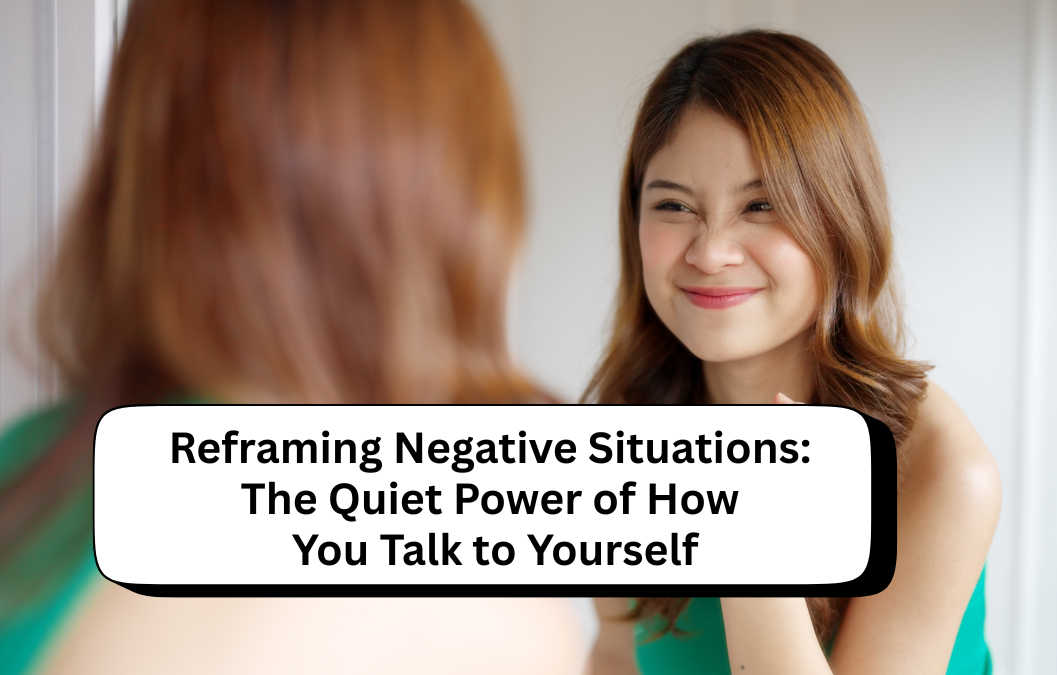
There’s a voice that follows you everywhere. It’s there when you wake up, when you’re rushing out the door, when something goes wrong, and especially when you’re tired, vulnerable, or feeling a little behind in life.
It’s your self-talk – the running commentary in your mind. And for many of us, it’s far harsher than anything we’d ever say out loud.
We’re quick to reassure friends, to soften the edges of their mistakes, to remind them they’re doing their best. Yet when it comes to ourselves? The tone changes. Suddenly it’s critical, impatient, and unforgiving.
What’s striking is how quietly damaging negative self-talk can be. It doesn’t scream. It whispers – and because of that, we often accept it as truth.
Here’s what reframing can look like in everyday life.
1. That afternoon slump hits (again)
You know the one. It’s mid-afternoon, your brain feels foggy, and concentration is a struggle.
The inner critic says:
Here we go. I’m useless in the afternoons. Nothing’s getting done now.
A kinder reframe:
My energy is dipping. That’s normal. Maybe it’s time for a short break or a change of pace.
Same situation. Totally different emotional outcome.
2. Someone points out a mistake
You open an email and see feedback or corrections on something you worked hard on.
The inner critic says:
They must think I’m incompetent.
A kinder reframe:
This is fixable. Feedback doesn’t mean failure – it means progress.
3. You forget something basic (because you’re human)
You left the washing out overnight. Now everything’s still damp.
The inner critic says:
Honestly, what is wrong with me? I can’t do anything right.
A kinder reframe:
Well, that’s annoying – but not a personal flaw. I’ll work around it.
It’s amazing how often we turn small inconveniences into sweeping judgments about our worth.
4. A familiar, loaded comment from family
A parent offers a compliment… with a sting attached.
The inner critic says:
Nothing I do is ever good enough.
A kinder reframe:
That’s their pattern – not my reality. I actually like how I look.
Reframing doesn’t mean pretending something doesn’t hurt. It means not letting it define you.
5. You weren’t invited
You find out friends caught up without you.
The inner critic says:
They don’t like me. I must have done something wrong.
A kinder reframe:
They probably just caught up spontaneously. I’ll reach out next time.
Our minds are brilliant storytellers – but not all the stories are true.
6. You’re doing “everything right”… and the scale disagrees
You’ve been moving your body, eating well, showing up for yourself – and then the number goes up.
The inner critic says:
What’s the point? This clearly isn’t working.
A kinder reframe:
I feel stronger. I have more energy. My body is responding in ways that matter beyond a number.
Progress doesn’t always look the way we expect it to.
7. You tried – and it didn’t land
You poured time, energy, and hope into something… and the response was underwhelming.
The inner critic says:
I knew it. I’m just not cut out for this.
A kinder reframe:
I created something and put it into the world. That takes courage. This isn’t the end – it’s feedback.
Trying and failing is still trying. And trying changes you.
Why This Matters More Than We Think
Negative self-talk doesn’t motivate us. It drains us. It keeps us small, hesitant, and stuck in cycles of self-doubt. And the more often we repeat those thoughts, the more familiar – and believable – they become.
Positive self-talk isn’t about forced optimism or pretending everything is fine. It’s about choosing a voice that supports rather than sabotages you. One that acknowledges the situation without attacking your character.
The shift can be subtle, but the impact is powerful.
Next time you catch that critical voice mid-sentence, pause. Ask yourself: Would I say this to someone I love? If the answer is no, it might be time to rewrite the script.
Not perfectly. Just kindly.